
You check your phone and it gives you a number for the humidity. It doesn't look that bad. Then you step outside and it feels like you can drink the air. What happened?
The problem is that number you looked at is relative humidity, when the better number is the dew point. And most weather apps either bury the dew point in a secondary screen or don’t show it clearly at all.
The reason relative humidity is so confusing is that it's a measure of how full the air is compared to how much it can hold at that temperature and warm air can hold way more moisture than cool air. The same number can mean two completely different amounts of water depending on the temperature. It tells you how full the glass is, but not how big the glass is. And the glass changes size depending on the temperature.
Dew point is different. It's the temperature the air would have to cool down to for condensation to form, and it's measured in degrees just like the air temperature. A 70° dew point means the same amount of moisture whether it's 80° or 100° outside. The relative humidity number changes on those two days. The amount of water in the air does not. Dew point is the honest number.
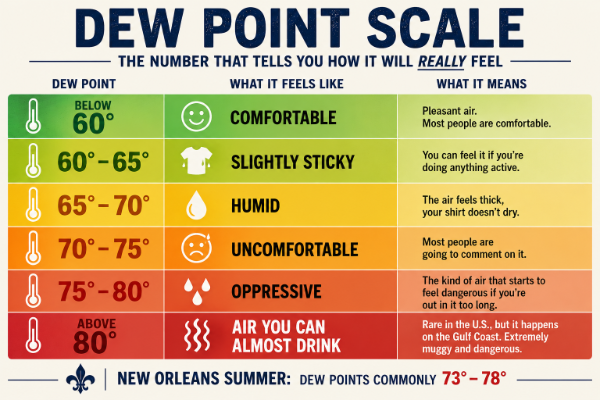
Here's a rough scale that forecasters use. Below 60° is comfortable, you might notice it's a little humid if you're from somewhere dry, but most people are fine. 60° to 65° is slightly sticky. You can feel it if you're doing anything active. 65° to 70° is humid, the air feels thick, your shirt doesn't dry. 70° to 75° is uncomfortable and most people are going to comment on it. 75° to 80° is oppressive, the kind of air that starts to feel dangerous if you're out in it too long. Above 80° is rare in the US, but it happens on the Gulf Coast, and that is air you can almost drink.
In New Orleans in the summer, June through August have dew points in the 73° to 78° range. That's not just muggy. That's the high end of that scale. There is more water in the air during summer than almost anywhere in the country besides maybe Houston or the Florida Panhandle.
Here's a real world comparison. Say it's 95° in Phoenix with a dew point around 40°. Hot, sure, but dry. Your sweat evaporates. Your body's cooling system works exactly how it's supposed to. You feel hot but you're not drenched.
Now say it's 85° in New Orleans with a dew point around 76°. The air temperature is ten degrees cooler than Phoenix, but it feels worse. Here's why.
Your body cools itself by sweating. When sweat evaporates off your skin, it carries heat away with it. But evaporation requires the air to have room for more moisture. When the air is already saturated, which is basically what a high dew point means, there's nowhere for that sweat to go. It just sits on your skin. You keep sweating, your shirt gets soaked, but none of it is actually cooling you down. That's the danger. In extreme cases, when the dew point gets high enough, your body can't cool itself at all, and that's when heat related illness becomes a real risk.
So when you want to know how the day is going to feel when you walk outside, check out the dew point. That’s going to let you know what’s going on and how to prepare for your day.
💬 Comments